Playable Media
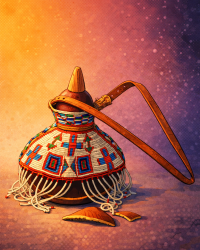
This project is a playable ethnography and archive of living traditions. In it,
I explore the social life of objects, the gendered labor of tradition-keeping, and the ephemerality and reinvention of culture in modern contexts. At its core, I ask: How can interactive media serve as both an archive and a mode of transmission for fragile cultural practices, particularly those carried through women’s everyday labor? Through this question, I use procedural storytelling to archive, interact with, and pass on heritage in ways that are at once critical and creative.
Mobilizing the themes of fragility and resilience, I focus on living memory in select practices of the Kamba people of Kenya. Kîkuu nîkyatûkîe [The Calabash is Broken] is a slow-play, culturally embedded digital experience that draws from the everyday textures of Kamba life passed through women’s hands. Rooted in ethnographic research and intimate family memory, the project centers on a traditional calabash—called kîkuu in my mother-tongue.
While kîkuu generally refers to a gourd used for storing liquids like milk, the kitete is a more elaborate gourd made by older women for a girl at marriage as part of her dowry. The bride would take this calabash with her to her new home and use it to feed her husband for the first time (British Museum 2025). She would later hang it in the home as an ornament, which is how I encountered my mother’s kitete. Since she always referred to it as kîkuu, I carry on this naming convention in my project. This particular calabash, given to my mother by my grandmother at her wedding, forms the narrative and symbolic core of the game. Already broken before I was born, it had been repaired in the traditional way, stitched with sisal through heat pierced holes, and hung in our home for years. Its recent re-breaking forms the starting point of this work. In the game, when the protagonist finds her mother’s broken wedding calabash, she is stirred into remembering the many things this object once carried—not just food or drink, but blessings, traditions, exchanges, and emotions. The player encounters the calabash as fragment. To repair it she moves through a series of tasks drawn from Kamba food practices: making ghee, pounding maize, fermenting porridge. Each level becomes both an act of cultural memory and an act of mending, inviting reflection on how identity and tradition are carried forward. Rather than restoring the calabash to an original, untouched state, the process foregrounds transformation marked by use, repair and persistence. This work treats play and interaction as method, archive and site of cultural knowledge.